Understanding CrossFit® Programming in Alexandria, VA
An independent guide to the CrossFit methodology—and a clear explanation of how Sand & Steel Fitness builds its own workout programming today.
What the CrossFit Methodology Means
CrossFit, LLC describes its methodology as a combination of varied functional movements performed at an intensity appropriate to the individual. Its published materials also emphasize scaling, measurable progress, and developing mechanics and consistency before increasing intensity.[1][2]
That methodology is broader than any single workout format. It can include short efforts, longer conditioning, strength work, gymnastics skills, Olympic lifts, running, rowing, and other training tools. The purpose of variation is to develop broad fitness, not to make every day random or to fit every possible element into every class.
Monostructural Training
Running, rowing, cycling, skiing, and similar work develop cardiovascular capacity, pacing, and stamina across different time domains.
Gymnastics
Bodyweight movements develop relative strength, coordination, balance, and control. Progressions make advanced skills teachable at an appropriate level.
Weightlifting
Barbells, dumbbells, kettlebells, and other external loads build strength and power through squatting, hinging, pressing, pulling, carrying, and Olympic-lifting patterns.
Relative Intensity
The intended challenge is adjusted to the athlete. Load, movement complexity, range of motion, repetitions, and time can all be scaled while preserving the training goal.
Good Programming Is More Than a Hard Workout
A useful daily workout has a clear purpose. A useful training week connects those daily purposes so strength, skill, conditioning, and recovery support one another over time.
The question is not whether a class contains both lifting and conditioning. The better question is whether the total dose, sequence, and progression fit the athlete and the goal.
What coaches should manage across the week
- Training intent: Each session should identify the main adaptation—strength, power, skill, speed, aerobic capacity, muscular endurance, or a combination.
- Volume and intensity: Hard work must be dosed so athletes can recover, retain movement quality, and continue progressing.
- Movement balance: Squat, hinge, push, pull, carry, locomotion, and trunk work should be distributed thoughtfully rather than crowded into every day.
- Progression: Repeated exposure and planned development matter. Variety works best when it sits inside a coherent plan.
- Scaling: The workout should meet the person training that day while preserving its intended stimulus.
- Coaching time: The class plan must leave room to teach, practice, correct, and cool down—not simply accumulate work.
How Sand & Steel Programs Today
Sand & Steel bases it’s programming from companies like Invictus, PRVN, HWPO and others to provide a comprehensive training structure. Our workouts are edited and customized for our community by Dawn Anderson and Paul Roberts. The plan uses professional, periodized tracks for strength, conditioning, and skill development, then our coaches adjust the delivery for the people training in front of us.
Performance
A barbell- and skill-forward Fitness Classes track with Olympic lifting, gymnastics progressions, strength development, and mixed-modal conditioning.
Foundations
A Fitness Classes track that runs alongside Performance with simpler movement choices and progressive loading through dumbbells, kettlebells, and bodyweight work.
HYROX Classes
Two weekly race-preparation sessions using running, sled work, carries, lunges, wall balls, and mixed-modal conditioning. Sand & Steel Fitness is an Official HYROX Training Club.
Personal Training and Running
Separate strength, conditioning, and running tracks support private coaching clients and trainees who use Sand & Steel programming through the app.
See the complete track descriptions, a sample week, and the current workout schedule on our Workout Programming page.
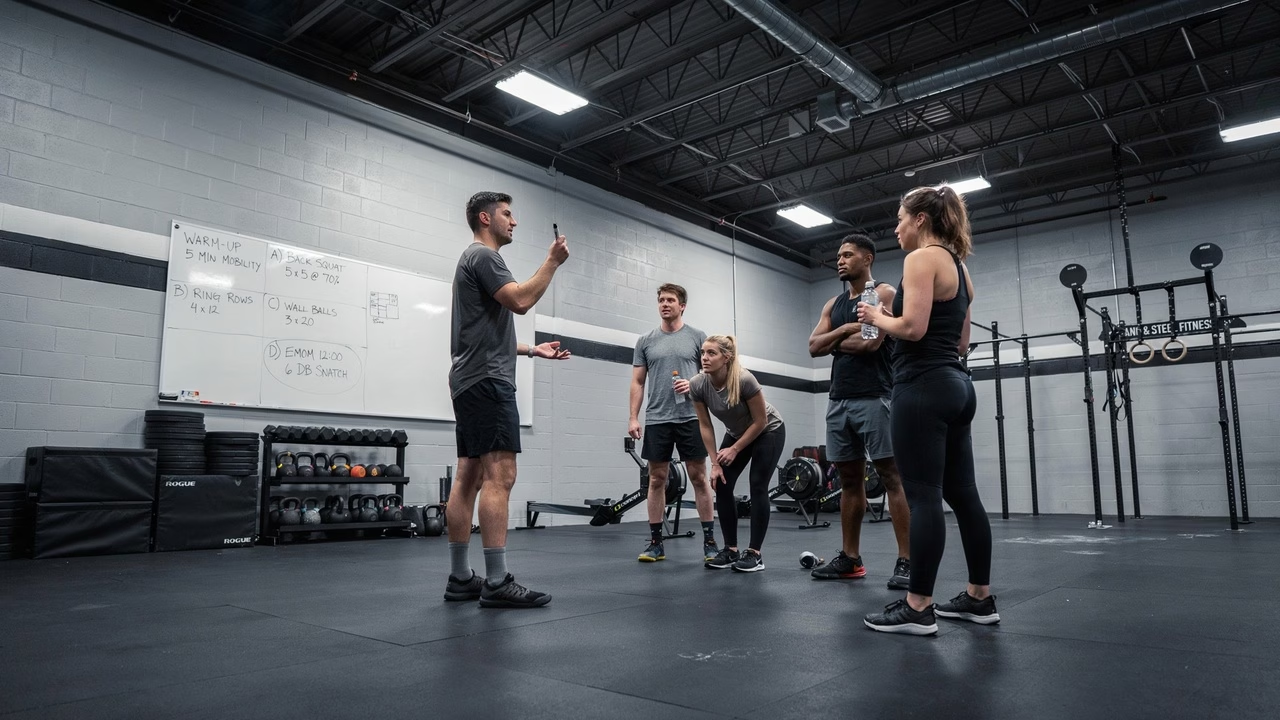
What a Sand & Steel Fitness Class Looks Like
Programming is only the plan. Coaching turns that plan into a safe, productive session for each member.
1. Whiteboard Brief
Your coach explains the purpose, movement standards, pacing, and available options before training begins.
2. Progressive Warm-Up
The warm-up raises temperature, prepares the relevant joints and tissues, and rehearses the movement patterns used that day.
3. Skill and Strength Work
Members practice positions and technique before adding speed, complexity, or load. Coaches provide individual cues and scaling.
4. Workout of the Day
The main effort follows the day’s intended stimulus. Movements, loading, repetitions, or duration are adjusted to the athlete.
5. Cooldown
The class finishes with a gradual transition out of training, targeted mobility, and guidance for recovery.
Small-Class Coaching
Classes typically average 4–8 members, giving coaches time to watch movement, teach progressions, and make meaningful adjustments.
CrossFit Level 3 credentials
While Paul Roberts and Dawn Anderson each hold the CrossFit Level 3 credential, we are not affiliated with CrossFit, nor do we offer CrossFit branded classes.
Sand and Steel Fitness is a great gym with an excellent coaching staff. Paul has incredible knowledge to help you with any mobility problems you have. He is also capable of designing a program that fits your needs and goals specifically. Dawn is an excellent programmer as well, she is able to create strength programs spanning the spectrum of novice to experienced weight lifter. Overall their coaching staff is professional, kind, and highly experienced.
Explore Sand & Steel Programming
See how our independent Fitness Classes, Personal Training, and running tracks work together—then choose the training format that fits your goals.
References and Trademark Notice
- CrossFit, LLC. “What Is CrossFit?”
- CrossFit, LLC. “Mechanics, Consistency, Intensity: What Does It Mean?”
- Sand & Steel Fitness. Workout Programming.
Trademark notice: CrossFit® is a registered trademark of CrossFit, LLC. Sand & Steel Fitness is not affiliated with, endorsed by, or sponsored by CrossFit, LLC.
In 2020, I transitioned from a focus in power lifting to crossfit. Sometimes I feel frustrated because the programming seems chaotic and untargeted for the type of progressive growth I was used to when primarily focusing on lifting heavy. This article was a great breakdown of why the programming is designed the way it is and the different metrics for growth and improvement. Thank you for the insight!
Thank you for taking the time to read it! You are right, CrossFit is not a dedicated powerlifting program using undulating progressive overload, nor is it a program designed to help you achieve your fastest marathon times. CrossFit’s greatest strength is improving your general physical preparedness across broad swaths of modalities and time domains. If your main goal is to be healthy and improve your overall fitness safely, CrossFit training as we coach it cannot be beat. 3-4 hours a week is all it takes.
I find lots of value in the programming at Sand&Steel, especially with safety and injury prevention at the forefront. This year, by showing up consistently, I’ve seen progress in every lift and my endurance has improved significantly – so, the programming has proven very effective for me.
Lori, you are absolutely crushing all your lifts and records. I wish everyone at Sand and Steel your success. Be consistent and scale correctly… Lori you are a champion!
Very good i like it